The Ouroboros Snake Eating Its Own Tail: An Ancient Symbol for Modern Sustainability
The image of the Ouroboros snake eating its own tail is one of the oldest and most profound symbols known to humanity. Appearing across diverse cultures and millennia, it universally represents eternity, cyclicality, and the eternal return. While its origins are steeped in ancient mysticism, this powerful motif offers surprisingly relevant insights into contemporary issues, especially the critical importance of recycling and embracing a circular economy. At Little Green Junk, we see echoes of this ancient wisdom in our daily work, transforming waste into resources and completing the loop.
Last updated: April 26, 2026
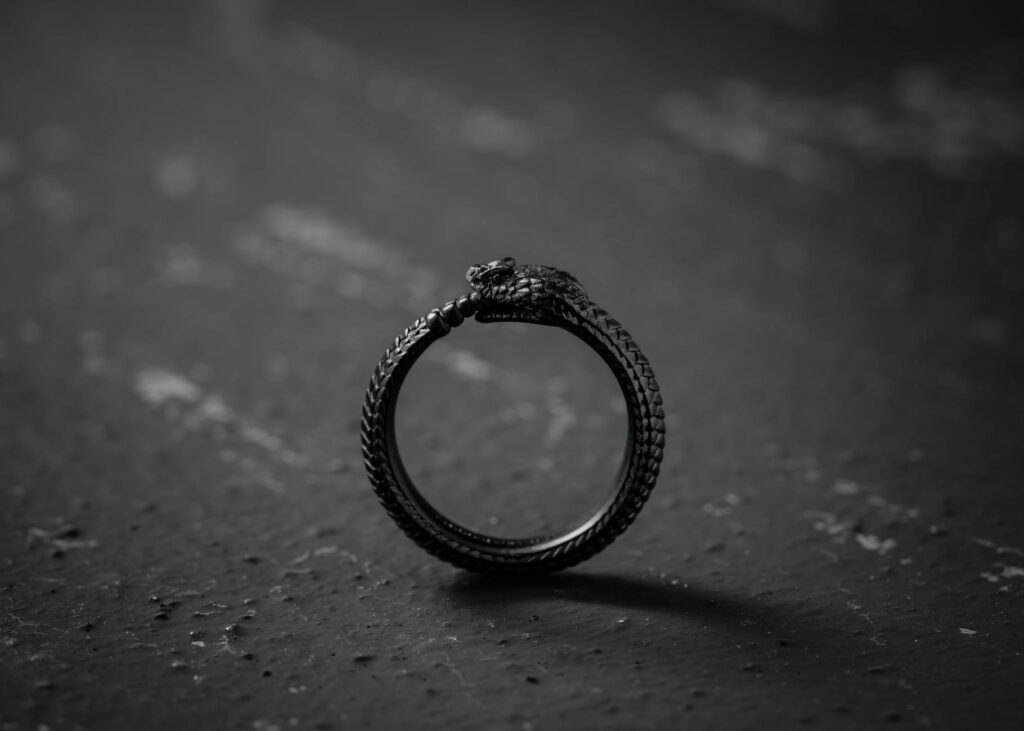
what’s the Ouroboros snake eating its own tail? it’s an ancient symbol depicting a serpent or dragon consuming its own tail, representing cycles of creation and destruction, renewal, and the concept of eternity. This symbol has appeared in various forms across ancient Egypt, Greece, and Norse mythology.
Ancient Symbolism of the Ouroboros
The Ouroboros, derived from the Greek words ‘oura’ (tail) and ‘boros’ (eating), is far more than just a striking image. Its core meaning revolves around the cyclical nature of existence. It speaks to the idea that life and death, beginnings and endings, aren’t linear but part of an ongoing, self-sustaining process. Think of the seasons, the life cycle of a star, or even the ebb and flow of history itself. The Ouroboros embodies this perpetual motion.
One of the earliest known depictions comes from the tomb of Tutankhamun in ancient Egypt, dating back to around 1323 BCE. This ancient artifact shows the sun god Ra in his underworld journey, surrounded by serpents, one of which is an Ouroboros, signifying the sun’s daily rebirth. Later, it was adopted by Stoic philosophers in ancient Greece — who saw it as a symbol of the cosmic cycle of creation and destruction, a concept that resonates with the idea of eternal recurrence, famously explored by Friedrich Nietzsche in his work ‘Thus Spoke Zarathustra’. According to The Cambridge Companion to Nietzsche (2006), Nietzsche viewed the eternal recurrence as a test of one’s affirmation of life.
The Ouroboros and the Circular Economy
While ancient cultures didn’t have waste management facilities or complex recycling plants, their understanding of natural cycles offers a direct parallel to the modern concept of the circular economy. The Ouroboros snake eating its own tail, in this context, becomes a potent metaphor for a system designed to eliminate waste and pollution, circulate products and materials, and regenerate nature.
Unlike the traditional linear ‘take-make-dispose’ model — which is unsustainable and creates mountains of waste, the circular economy aims to keep resources in use for as long as possible. This involves strategies like repairing, reusing, refurbishing, and, Keyly, recycling. The goal is to ‘close the loop,’ much like the Ouroboros completes its circle, ensuring that materials aren’t lost but are continually fed back into the system.
For instance, the Ellen MacArthur Foundation, a leading advocate for the circular economy, states that by 2015, the global economy was using resources at a rate that would require 1.7 Earths to sustain, highlighting the urgent need for a systemic shift. Their work emphasizes designing out waste and pollution from the outset, rather than dealing with the consequences.
Practical Recycling: Bringing the Ouroboros Home
How can we, as individuals and communities, embody the spirit of the Ouroboros in our daily lives? The answer lies in embracing conscious consumption and effective waste management. Little Green Junk is built on this principle: helping you responsibly manage unwanted items, diverting them from landfill wherever possible.
Here are some practical tips:
- Understand Your Local Recycling Streams: Familiarize yourself with what can and can’t be recycled in your area. For example, in the UK, councils like Camden Council provide detailed online guides on household recycling. Check your local authority’s website for specific guidelines on plastics, paper, glass, and metals.
- Reduce and Reuse First: The most effective way to ‘close the loop’ is to minimize waste generation in the first place. Opt for reusable bags, water bottles, and coffee cups. Before discarding an item, consider if it can be repaired, donated, or repurposed.
- Properly Sort Your Waste: Contamination is a major challenge in recycling. Ensure that items are clean and dry before placing them in recycling bins. For instance, rinsing out food containers prevents contamination of paper and cardboard.
- Composting Organic Waste: Food scraps and garden waste make up a significant portion of household waste. Composting turns this ‘waste’ into valuable nutrient-rich soil, embodying a natural cycle of renewal. Many home composting solutions, like the Worm Factory 3-Tray Composter, are readily available.
- Responsible Disposal of Bulky Items: When you have items that can’t be recycled through standard kerbside collections, like old furniture or appliances, professional junk removal services like Little Green Junk can help. We prioritize responsible disposal, aiming to donate, resell, or recycle items rather than sending them directly to landfill. In 2022, the UK generated approximately 227.5 million tonnes of waste, with local authorities managing around 111.8 million tonnes of this, according to the Department for Environment, Food &. Rural Affairs (DEFRA).
The Ouroboros in Business and Industry
Beyond individual actions, the Ouroboros symbol resonates deeply with businesses striving for sustainability. Companies are increasingly adopting closed-loop systems — where products are designed for durability and recyclability. This approach not only reduces environmental impact but can also lead to significant cost savings and innovation.
Consider the electronics industry. Companies are exploring ways to design phones and laptops that are easier to repair and dismantle, allowing valuable materials like gold, silver, and copper to be recovered at the end of their life. Here’s a direct application of the Ouroboros principle—turning the end of one product’s life into the beginning of another’s.
The concept of ‘product-as-a-service’ also aligns with this philosophy. Instead of selling a product outright, companies might lease it, retaining ownership and responsibility for its maintenance, repair, and eventual recycling. This incentivizes manufacturers to create durable, high-quality goods, as they remain accountable for them throughout their lifecycle.
Challenges and the Path Forward
While the vision of a perfectly cyclical economy is appealing, the reality presents challenges. Global supply chains are complex, and achieving true closed-loop systems requires significant infrastructure, technological advancement, and widespread consumer participation. According to the European Environment Agency (2023), while recycling rates are improving in many European countries, the overall resource efficiency still needs substantial enhancement.
For instance, the recycling of complex materials, such as mixed plastics or certain types of composites, remains difficult and often economically unviable. Also, the energy required for some recycling processes means that not all recycling is ‘green.’ This highlights the need for a complete approach that prioritizes reduction and reuse before recycling, truly embodying the Ouroboros’s focus on continuous, efficient cycles.
Frequently Asked Questions
what’s the primary meaning of the Ouroboros?
The primary meaning of the Ouroboros snake eating its own tail is eternity, cyclicality, and the eternal return. It symbolizes the cyclical nature of life, death, and rebirth, representing a self-sustaining and continuous process.
Where does the Ouroboros symbol originate?
The Ouroboros symbol has ancient origins, appearing in artifacts from ancient Egypt as early as the 14th century BCE. It was also adopted and used by the Greeks and later featured in Gnostic and alchemical traditions.
How does the Ouroboros relate to sustainability?
The Ouroboros relates to sustainability by symbolizing the cyclical processes inherent in nature and the circular economy. It represents the ideal of keeping resources in use, eliminating waste, and regenerating natural systems, much like a continuous, self-renewing cycle.
Is the Ouroboros a symbol of good or evil?
The Ouroboros is generally considered a neutral symbol representing fundamental natural processes. It can signify both creation and destruction, completion and renewal, without inherent moral judgment. Its interpretation often depends on the cultural or philosophical context.
What are practical ways to live by the Ouroboros principle?
Practical ways to live by the Ouroboros principle include actively reducing waste, reusing items, repairing what’s broken, and recycling responsibly. Embracing a circular economy mindset in daily choices, from conscious purchasing to proper waste disposal, helps close the loop.
Embracing the Cycle with Little Green Junk
The Ouroboros snake eating its own tail works as a powerful reminder that endings are often new beginnings. In our modern world, this ancient wisdom translates directly into the principles of recycling and the circular economy. By understanding and applying these concepts, we can move away from a wasteful, linear system towards one that’s regenerative and sustainable.
Whether it’s through diligent household recycling, choosing reusable products, or utilizing professional services like Little Green Junk for responsible disposal of unwanted items, every action contributes to closing the loop. we’re committed to helping you manage your waste in a way that respects the Ouroboros’s message of renewal and continuity, ensuring that materials are given new life rather than ending up in landfill. Let’s work together to make our consumption cycles more sustainable.