
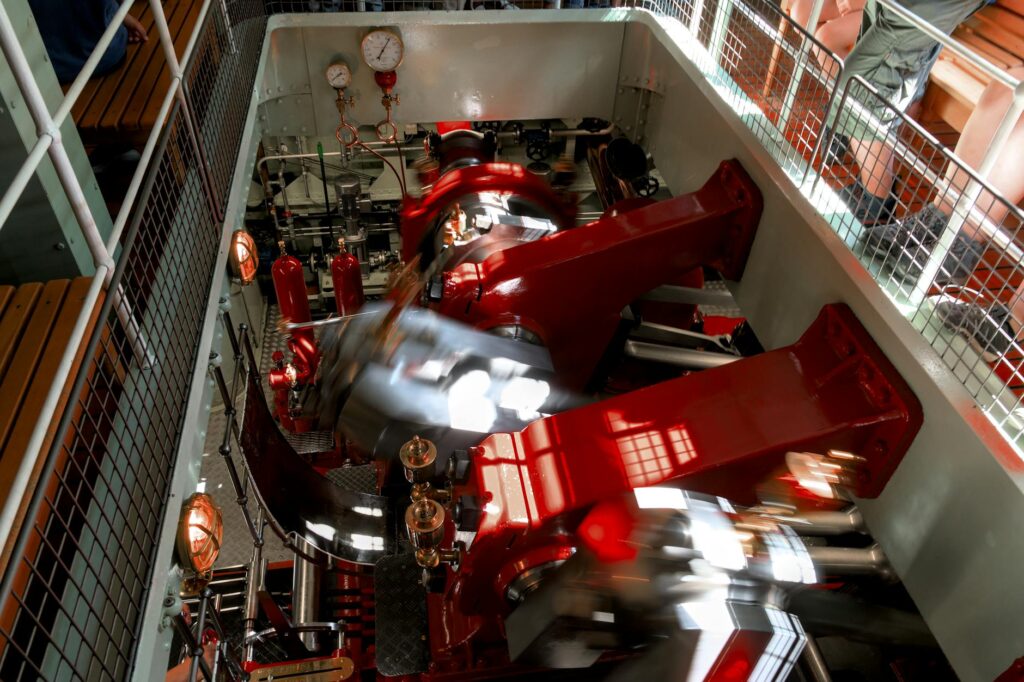
What Exactly Is Mechanical Energy?
Imagine a child on a swing, soaring back and forth. That motion — that height—it’s all powered by mechanical energy. At its core, the mechanical energy definition is straightforward: it’s the total energy an object possesses due to its motion or its position relative to a force field. It’s a fundamental concept in physics that explains a vast array of phenomena, from the simplest act of lifting an object to the complex workings of power generation.
Last updated: April 22, 2026
Mechanical energy is basically the sum of two other forms of energy: kinetic energy and potential energy. Kinetic energy is the energy of movement, while potential energy is stored energy based on an object’s position or configuration. Together, they paint a complete picture of an object’s mechanical energy.
The Two Pillars: Potential and Kinetic Energy
To truly grasp mechanical energy, we must first understand its two constituent parts. they’re always present, though their distribution may change.
Kinetic Energy: The Energy of Motion
Kinetic energy (KE) is the energy an object possesses because it’s in motion. The faster an object moves and the more mass it has, the greater its kinetic energy. For instance, a speeding train has far more kinetic energy than a cycling bicycle, simply because of its much larger mass and velocity.
The formula for kinetic energy is relatively simple: KE = 1/2 m v^2 — where ‘m’ is the mass of the object and ‘v’ is its velocity. This formula highlights how velocity plays a more significant role than mass. doubling the velocity quadruples the kinetic energy. According to the Encyclopædia Britannica (2023), kinetic energy is a scalar quantity, meaning it only has magnitude and no direction.
Potential Energy: The Energy of Position or State
Potential energy (PE) is stored energy. It’s the energy an object has due to its position in a force field (like gravity) or its internal state. The most common type we encounter is gravitational potential energy — which is the energy an object possesses because of its height above a reference point. Lifting a book onto a shelf stores gravitational potential energy in the book.
The formula for gravitational potential energy near the Earth’s surface is PE = m g h — where ‘m’ is mass, ‘g’ is the acceleration due to gravity (approximately 9.81 m/s² in the UK), and ‘h’ is the height above the reference point. Another form is elastic potential energy, stored in objects like stretched rubber bands or compressed springs.
Putting It Together: Total Mechanical Energy
Total mechanical energy (ME) is the sum of an object’s kinetic and potential energies. ME = KE + PE.
Consider a simple pendulum. At the highest point of its swing, its velocity is momentarily zero, so its kinetic energy is zero. All its mechanical energy is in the form of potential energy due to its height. As it swings downwards, its height decreases, reducing its potential energy, but its velocity increases, boosting its kinetic energy. At the bottom of the swing, its height is at a minimum (often considered zero), and its velocity is at a maximum. Here, most of its mechanical energy is kinetic.
“The principle of conservation of energy states that energy can’t be created or destroyed, only converted from one form to another.” — Albert Einstein, paraphrased from his work on the subject
The Law of Conservation of Mechanical Energy
One of the most profound principles related to mechanical energy is the law of conservation of mechanical energy. In an isolated system where only conservative forces (like gravity and the elastic force of a spring) are acting, the total mechanical energy remains constant. Energy can transform between kinetic and potential forms, but the sum stays the same.
This principle is fundamental to understanding many physical systems. For example, the roller coaster at an amusement park relies heavily on this concept. As the coaster climbs a hill, it gains potential energy. As it descends, this potential energy is converted into kinetic energy, making it move faster. If we ignore friction and air resistance, the total mechanical energy at any point on the track would be the same.
However, in real-world scenarios, non-conservative forces like friction and air resistance are almost always present. These forces do work and dissipate mechanical energy, often as heat or sound. According to the U.S. Department of Energy (2024), in practical applications, mechanical energy is often transformed into other forms like thermal energy due to these resistive forces.
Mechanical Energy in Everyday Life
While we may not consciously calculate it, mechanical energy is at play everywhere around us.
Simple Machines and Mechanical Advantage
Simple machines—like levers, pulleys, inclined planes, and wheels and axles—are devices that change the direction or magnitude of a force. they’re designed to make work easier by providing mechanical advantage. For instance, using a lever to lift a heavy rock multiplies the force you apply, allowing you to move an object that would otherwise be too heavy.
A pulley system, for example, can lift heavy loads with less effort. The mechanical advantage (MA) of a pulley system is basically a measure of how much it multiplies the input force. While simple machines don’t create energy (per the conservation law), they redistribute it to make tasks more manageable. The BBC Bitesize (Year not specified, but content is regularly updated) explains that simple machines reduce the effort needed by increasing the distance over which the force is applied.
Automobiles and Transportation
The engine in a car converts chemical energy from fuel into mechanical energy to move the vehicle. This mechanical energy is then transmitted through the drivetrain to the wheels, causing them to rotate and propel the car forward. Braking systems, conversely, convert the car’s kinetic energy back into thermal energy through friction to slow it down.
Renewable Energy Technologies
Many renewable energy sources harness mechanical energy. Wind turbines capture the kinetic energy of the wind, converting it into rotational mechanical energy — which then drives a generator to produce electricity. Hydropower plants use the potential energy of water stored at a height (in dams) or the kinetic energy of flowing rivers to spin turbines, again generating electricity.
Even solar panels, while primarily converting light energy into electrical energy, often involve mechanical components like tracking systems that adjust their orientation to maximise sunlight capture. The efficiency of these mechanical systems is Key for the overall performance of renewable energy technologies.
Calculating Mechanical Energy: A Practical Example
Let’s consider a practical scenario. Imagine you’re using a rope and pulley system to lift a 50 kg crate of old electronics (perhaps destined for Little Green Junk!) from the ground to a height of 3 meters. Let’s assume, for simplicity — that the pulley system itself is frictionless and has no mass, and we’re ignoring air resistance. The acceleration due to gravity, g, is 9.81 m/s².
First, let’s calculate the potential energy gained by the crate. The initial potential energy (on the ground) can be considered zero. The final potential energy (PE) is given by PE = mgh.
PE = 50 kg 9.81 m/s² 3 m = 1471.5 Joules (J).
Now, let’s say you pull 6 meters of rope to lift the crate. If the pulley system gives you a mechanical advantage of 2 (meaning you only need to apply half the force you would otherwise), you would have exerted a force over that 6-meter distance. The work done by you is equal to the energy transferred. In an ideal system without friction, the work you do equals the potential energy gained by the crate.
The initial kinetic energy of the crate and the rope is zero. As you lift it, it gains some kinetic energy, but if we assume a slow, steady lift, the kinetic energy is minimal at any given moment and is converted back into potential energy as the crate moves upwards. The total mechanical energy of the crate increases from 0 J to 1471.5 J.
When Mechanical Energy Isn’t Conserved
It’s vital to remember that the strict conservation of mechanical energy only applies when non-conservative forces are absent. In the real world, friction is ubiquitous. Think about:
- Sliding Friction: When you slide a box across the floor, friction opposes the motion, converting mechanical energy into heat.
- Air Resistance: A falling object encounters air resistance — which slows it down and dissipates its kinetic energy as heat.
- Internal Friction: In mechanical systems with moving parts, like engines or gearboxes, friction between components generates heat and reduces efficiency.
Companies like SKF, a global leader in bearings and seals, develop technologies In particular to minimise this internal friction in rotating machinery, thereby preserving mechanical energy and improving efficiency.
Practical Tips for Understanding Mechanical Energy
Understanding mechanical energy can be more than just academic. Here are some practical ways to think about it:
- Observe Your Surroundings: Notice the motion and position of objects. A ball held high has potential energy. a thrown ball has kinetic energy. A bouncing ball demonstrates the conversion between the two.
- Think About Efficiency: When using tools or appliances, consider how much of the input energy becomes useful mechanical energy. For example, modern energy-efficient appliances are designed to minimise energy loss to heat and sound.
- Consider Potential for Work: An object raised to a height has the potential to do work when it falls. Here’s why hydroelectric dams are built—to harness that potential energy.
- Safety First: kinetic energy involved in moving objects (like vehicles) is Key for safety. The faster something moves, the more energy it has, and the harder it’s to stop.
Frequently Asked Questions
what’s the core definition of mechanical energy?
The mechanical energy definition refers to the total energy an object possesses due to its motion (kinetic energy) and its position or state (potential energy).
Is mechanical energy the same as potential energy?
No, mechanical energy is the sum of kinetic energy (energy of motion) and potential energy (stored energy due to position or state).
What happens to mechanical energy when there’s friction?
When friction is present, mechanical energy is typically not conserved. it’s converted into other forms of energy, primarily heat and sound, due to the work done by friction.
Can mechanical energy be created or destroyed?
According to the law of conservation of energy, mechanical energy can’t be created or destroyed. it can only be transformed into other forms of energy or from kinetic to potential energy and vice versa.
What are some common units for measuring mechanical energy?
Mechanical energy, like other forms of energy, is typically measured in Joules (J) in the International System of Units (SI). In the imperial system, it might be measured in foot-pounds (ft-lb).
Conclusion
The mechanical energy definition—the sum of kinetic and potential energy—provides a fundamental lens through which to view the physical world. From the simple act of lifting an object to the complex operation of renewable energy systems, understanding how energy moves and transforms is key. While the ideal scenario of conserved mechanical energy is fascinating, acknowledging the impact of non-conservative forces like friction is Key for practical applications. By observing these principles in action, we gain a deeper appreciation for the science that powers our world and informs our choices about efficiency and sustainability.
Editorial Note: This article was researched and written by the Little Green Junk editorial team. We fact-check our content and update it regularly. For questions or corrections, contact us.